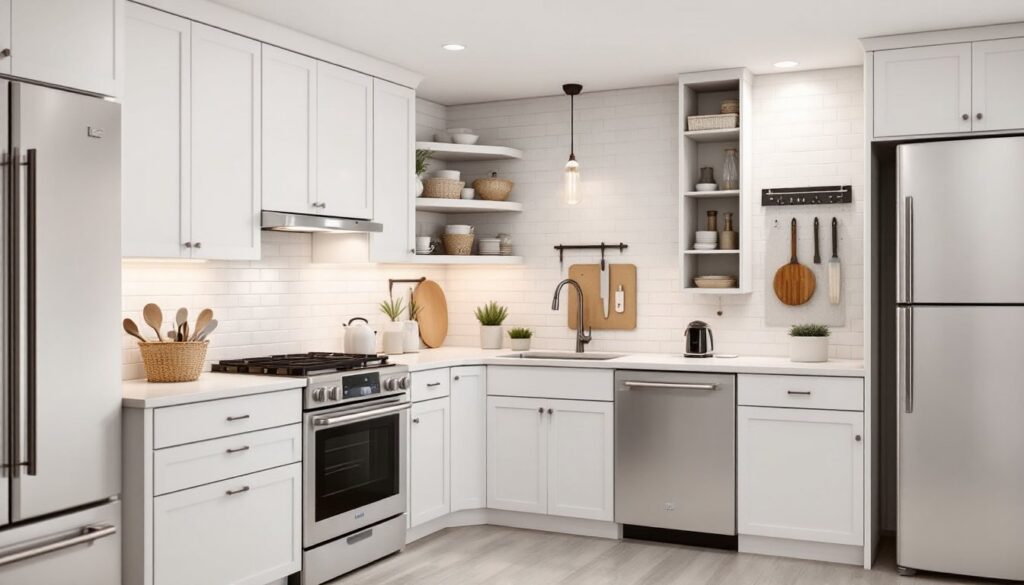
Corner kitchens are tricky real estate. They’re often overlooked, cramped, and a puzzle to navigate efficiently. But they don’t have to be. Whether you’re dealing with a small apartment, a secondary kitchen, or just an awkward nook that needs purpose, small corner kitchen ideas can transform that wasted space into a functional, organized hub. The key is strategic planning, measuring twice, thinking vertically, and choosing fixtures that earn their footprint. Let’s walk through how to assess what you’ve got, then build a layout that actually works for cooking, storage, and movement.
Table of Contents
ToggleKey Takeaways
- Small corner kitchen ideas require strategic planning, starting with accurate measurements of wall lengths, ceiling height, and traffic flow to avoid costly mistakes later.
- Maximize storage using rotating lazy susan cabinets, floating shelves, pegboards, and wall-mounted organizers to transform underutilized corner space into functional storage.
- Combat the shadowy appearance of corner kitchens with layered lighting—under-cabinet LED strips, pendant lights, and recessed fixtures—combined with light, neutral cabinet finishes and reflective surfaces.
- Choose compact appliances like slimline dishwashers (18 inches wide) and shallow-depth refrigerators (24–26 inches) to fit your corner layout without sacrificing workspace.
- Optimize workflow by positioning your sink as the anchor point, ensuring 18–24 inches of prep counter space, and planning appliance door swings to prevent collisions in tight spaces.
Assess Your Corner Kitchen Layout
Before you buy a single shelf or appliance, take a long, honest look at your corner. Measure the wall lengths, note the ceiling height, and identify fixed elements, windows, doors, electrical outlets, and plumbing stubs. Use a tape measure (not your eye), and write everything down. Mark the traffic flow: where does someone naturally move to get from the fridge to the stove to the sink?
Check your corner angles, too. Many corners aren’t perfect 90 degrees: they’re slightly off, which matters when you’re fitting cabinetry or appliances. Take photos from multiple angles. If this corner connects to a dining area or living room, note how it’s visible from those sightlines, this influences your color and material choices. Your corner kitchen layout determines everything downstream, so invest fifteen minutes now to save hours of guesswork later.
Strategic Storage Solutions for Tight Spaces
Storage is the lifeblood of a functional corner kitchen. Dead-end cabinet spaces, blind corners, and above-the-counter gaps are your best friends if you know how to use them.
Corner cabinets and lazy susans are workhorses here. A standard 36-inch corner cabinet with a rotating lazy susan (sometimes called a carousel or magic corner) lets you use that otherwise unreachable back space. Install one with soft-close hinges so it doesn’t slam at 6 a.m.
Open shelving works well for frequently used items or display pieces. A 24-inch or 30-inch deep floating shelf above your counter adds personality and storage without visual heaviness. Anchor shelves securely to wall studs using 2.5-inch lag bolts: don’t trust drywall anchors alone for dishes and cookbooks.
Drawer dividers and pull-out baskets maximize cabinet interiors. Many corner kitchens have cramped lower cabinets: a pullout basket on full-extension undermount slides lets you access the back without excavating.
Vertical Storage and Wall-Mounted Options
Go vertical. Wall space is cheap: floor space is gold. Install a pegboard (1/4-inch hardboard anchored to studs) for hanging pots, pans, utensils, and measuring spoons. Alternatively, a magnetic strip mounted at eye level holds knives safely and looks clean. Adhesive backsplash organizers and spice racks steal minimal real estate. A tension rod mounted inside a lower cabinet door creates hanging space for dish towels or spray bottles.
Don’t underestimate corner shelving units (sometimes called ladder shelves or corner racks). A tall, narrow unit fits snugly into a corner and holds ten to fifteen items across four or five tiers. Pair it with labeled baskets for a small corner kitchen ideas that stays organized. Wall-mounted magnetic strips, hooks, and rails all add storage layers without footprint sacrifice.
Lighting and Color to Enhance Your Corner Kitchen
Corners trap shadow. A corner kitchen that’s dark feels smaller and more cramped than it is. Combat this with layered lighting: ambient overhead light, task lighting above the counter, and accent lighting to create depth.
Under-cabinet LED strips (12–24 watts, 3000–4000K color temperature) illuminate your counter work surface and bounce light up to the walls. Install them 2–3 inches from the front edge of the cabinet, using aluminum channels for diffusion and heat management. Low-voltage LED strips run cool and draw minimal power: opt for warm white (3000K) if you prefer coziness, or neutral (4000K) for clarity.
A small pendant or track light focused on the counter adds focused task lighting. Avoid bulky fixtures that eat visual real estate: look for slim, angled designs. Recessed lights (6-inch or 4-inch cans) set into the ceiling work well if you have access to joist space: they’re nearly invisible and provide general ambient light.
Color and finish choices matter enormously. Light, neutral tones, soft whites, pale grays, warm beiges, make a corner kitchen feel airier. A glossy or semi-gloss cabinet finish bounces light: matte or satin absorbs it. Keep backsplashes and countertops light-toned as well. If you want color, use it as an accent (a painted upper cabinet or a bold backsplash tile) rather than throughout. Mirrors or reflective surfaces on one wall can bounce light and create a sense of expanded space without structural changes.
Compact Appliances and Fixtures That Work
Standard appliances are designed for standard kitchens. Your corner doesn’t fit that mold, so compact and scaled-down appliances are your friends.
Slimline dishwashers (18 inches wide instead of the standard 24 inches) fit between cabinetry without forcing you to sacrifice under-counter storage. Brands like Bosch, Miele, and Fisher & Paykel make reliable models. A compact range (24–30 inches) or a cooktop + separate oven configuration lets you distribute appliances across the corner rather than clustering them. Shallow-depth refrigerators (24–26 inches instead of 30 inches) save precious floor space if your corner doesn’t have a dedicated fridge zone. Under-counter beverage coolers are another space-saver if you want cold storage without a full fridge footprint.
Faucets and sinks deserve attention too. A corner sink positions itself at the 90-degree intersection, which can be awkward. A corner sink with a rounded or angled front (not a standard square) improves ergonomics. A pull-down or pull-out faucet with a flexible hose lets you reach both sides of the sink without twisting. Mount the faucet slightly off-center toward the larger side of the counter to avoid hitting cabinet edges.
If you’re installing kitchen inspiration ideas in a rental or want a temporary setup, consider portable induction cooktops, compact air fryers, or small beverage coolers that plug in without permanent installation.
Layout and Workflow Tips for Corner Kitchens
The work triangle, sink, stove, refrigerator, is your workflow template. In a corner kitchen, this triangle often compresses or distorts. Accept that: don’t fight it. Instead, optimize the path you actually walk.
Position your sink where you spend the most time, or where plumbing already exists (moving plumbing requires permits and professional work in most jurisdictions). The sink is your anchor. Build the stove and refrigerator around it as logically as possible. If the stove ends up three feet from the sink, so be it, a couple of prep steps longer isn’t a dealbreaker.
Keep the counter between sink and cooktop clear for prep work. Aim for at least 18–24 inches of uninterrupted counter space. In a tight corner, this might mean storing your utensil crock or fruit bowl elsewhere.
Appliance doors swing toward the room, not into each other. A refrigerator door swinging into an oven door is a recipe for angry mornings. Measure door swing paths and ensure they don’t collide with cabinet doors, drawers, or island seating.
Install a corner pantry or tall cabinet at 84 inches height (floor to top) if you have the vertical space. This centralizes non-refrigerated staples and frees up counter clutter. Label shelves or use clear bins so you know what’s inside without opening every container.
Resources like The Kitchn and Apartment Therapy offer real layouts and before-and-after remodels that show how others solved similar workflow puzzles. Study what worked for them, then adapt to your own corner’s quirks.
Conclusion
A small corner kitchen isn’t a limitation, it’s a design challenge that pushes you to be intentional. By assessing your layout honestly, maximizing vertical storage, using light and color strategically, choosing appropriately scaled appliances, and optimizing your workflow, you turn dead space into a functional kitchen that works for you. The result is a corner that feels bigger, brighter, and genuinely useful. Start with one or two changes, live with them for a month, and then refine. You’ll be surprised what a corner can do.