The kitchen is the heartbeat of the home, where meals happen, families gather, and design decisions matter. If your cabinets and countertops feel outdated or cramped, the good news is you don’t need to gut the space to get results. Whether you’re refreshing 20-year-old oak cabinetry with a fresh paint job or swapping countertops for something more durable, kitchen cabinet and countertop ideas range from weekend projects to larger investments. This guide walks you through popular styles, materials that earn their keep, budget-savvy updates, and the storage and finishing touches that pull everything together.
Table of Contents
ToggleKey Takeaways
- Kitchen cabinet and countertop ideas range from budget-friendly painting projects ($200–500) to larger countertop replacements, allowing homeowners to refresh their space without a full renovation.
- Quartz countertops lead the market due to their durability, nonporous surface, and minimal maintenance needs, though natural stone and laminate offer cost-effective alternatives depending on your cooking habits and budget.
- Painting existing cabinets delivers 80% of the visual impact of replacement at a fraction of the cost, but success depends on thorough surface preparation and quality enamel paint like Sherwin-Williams or Benjamin Moore Advance.
- Strategic color combinations like dark cabinets with light countertops or two-tone cabinetry create visual impact and harmony, with islands and secondary zones providing excellent opportunities to introduce bold colors.
- Smart storage solutions—vertical dividers, pull-out drawers, lazy Susans, and door-mounted racks—maximize functionality and prevent cabinet chaos, while under-cabinet LED lighting and soft-close hinges serve as high-impact finishing touches.
- Shaker-style and flat-panel cabinets remain the most versatile options for modern kitchens, working seamlessly with nearly any décor, countertop material, and design aesthetic.
Popular Cabinet Styles for Modern Kitchens
Today’s kitchen cabinets break into a handful of cohesive styles, each with distinct hardware, finishes, and door profiles. Shaker-style cabinets remain the workhorse of residential kitchens because they work with nearly any décor, five-piece frame doors with a center panel, clean lines, minimal ornamentation. They read as traditional or contemporary depending on paint color and hardware.
Flat-panel (or slab) cabinets offer a minimalist look with no frame or profile, just smooth door surfaces. They suit modern and contemporary kitchens and are easier to wipe clean than recessed panels. Inset cabinets, where the door sits flush with the frame rather than overlapping it, cost more labor-intensive to build but deliver a polished, built-in appearance.
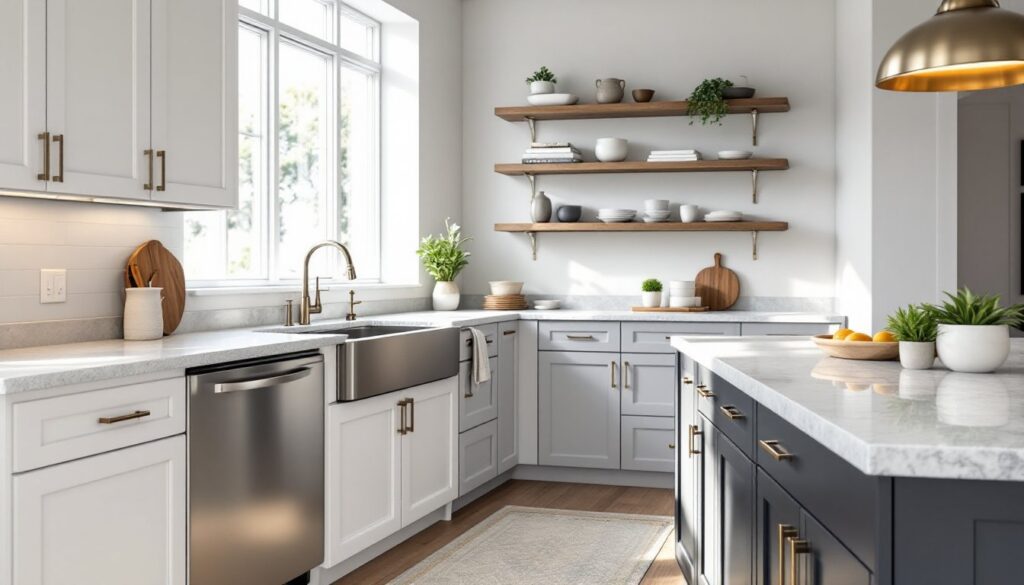
Open shelving has carved out a niche for homeowners willing to keep displayed items tidy. Floating shelves in stainless steel, powder-coated metal, or wood sit above the counter for quick access to frequently used bowls, glasses, or cookbooks. Mix open and closed storage to avoid the kitchen feeling chaotic.
Finishes matter as much as style. White and cream cabinets brighten small kitchens and pair with virtually any countertop material. Gray tones (greige, warm gray, soft charcoal) are popular for their versatility. Bold colors like navy, forest green, or black work when balanced with lighter countertops or natural wood accents. Two-tone cabinetry, say, navy on the perimeter and white on the island, adds visual interest without overwhelming the space.
Countertop Materials That Combine Durability and Aesthetics
Your countertop takes the heat, the knife marks, and the spills, so material choice drives both function and feel. Quartz engineered stone leads the market because it’s nonporous (no sealing required), resists staining, and comes in hundreds of colors and patterns. It costs more upfront, roughly $60–120 per linear foot installed, but holds its own for 20+ years with minimal maintenance.
Granite and marble offer natural stone appeal. Granite is durable and heat-resistant but needs periodic sealing (typically annually) and doesn’t tolerate acidic foods well without care. Marble is softer and stains easily, making it better for low-traffic zones or those comfortable with patina and upkeep. Both run $40–150+ per linear foot depending on stone quality.
Laminate remains the budget option at $10–30 per linear foot installed. Modern laminates mimic wood and stone convincingly, resist scratches reasonably well, and suit rental updates or temporary solutions. They can’t handle hot pans directly and can delaminate at edges if water breaches the seams.
Butcher block (typically maple or walnut) brings warmth and texture. It’s food-safe and kind to knives but requires periodic oiling and care to prevent staining and moisture damage. It works best in secondary zones, not as the primary prep surface. Stainless steel is commercial-looking, hygienic, and durable but noisy, fingerprint-prone, and reflective in ways some homeowners find cold.
When selecting countertop material, consider your cooking habits, budget, and maintenance tolerance. A busy family cooking daily might prioritize durability and low maintenance over stone aesthetics.
Budget-Friendly Updates: Painting and Refinishing Existing Cabinetry
Replacing cabinetry can easily exceed $10,000–$20,000+. If your bones are sound but the finish is tired, painting cabinets delivers 80% of the visual impact for a fraction of the cost. The key is thorough prep: every rushed cabinet paint job fails at the surface preparation stage.
The process:
- Remove doors, hardware, and shelves. Label everything so reassembly is straightforward.
- Clean thoroughly with TSP (trisodium phosphate) or a degreaser to strip built-up grime and reduce adhesion problems.
- Sand or prime. Sand with 120–150 grit to degloss glossy finishes, or use a bonding primer rated for cabinets. Sherwin-Williams Enamel or Benjamin Moore Advance are industry standards for cabinet paint because they level well, hide brush marks, and cure to a hard, washable finish.
- Apply two coats of quality cabinet enamel, allowing proper dry time between coats (check the product label, some cure for 24–30 days before reaching full hardness).
- Reinstall hardware and doors once fully cured.
Expect to spend $200–500 in materials and 30–50 hours of labor (your own time, or hire a painter for $1,500–$3,000). The results can look like new cabinetry.
Refinishing solid wood cabinets follows a similar path but may include staining if you want a color change. If cabinets are particleboard or veneer, painting is the only viable refinish option.
For those willing to invest a bit more, replacing cabinet doors alone (keeping the existing boxes) costs $1,500–$3,500 and sidesteps the painting timeline. Pair this with new hardware and a fresh countertop for a kitchen that feels completely transformed.
Color Combinations That Create Visual Impact
Color psychology in the kitchen goes beyond personal preference, certain pairings work because they balance visual weight and create harmony.
Neutral on neutral (cream cabinets with white or beige countertops) feels airy and timeless but can read as bland if hardware and accessories don’t add interest. Add warmth with brass or bronze hardware and natural wood open shelving.
Dark cabinets with light countertops (navy cabinets with white quartz, for example) creates high contrast and drama. This pairing works in kitchens with good natural light: in dim kitchens, dark cabinetry can absorb light and feel cave-like.
Light cabinets with dark countertops flips the script: white or pale gray cabinets paired with charcoal quartz or black granite keeps the space feeling open while anchoring the counter zone visually. This is a versatile, forgiving combination.
Warm wood tones with stone countertops evokes a transitional or rustic aesthetic. Natural wood cabinetry (or stained cabinetry in warm oak, cherry, or walnut shades) pairs beautifully with granite or engineered stone that echoes the wood’s warmth.
Two-tone cabinetry intentionally pairs upper and lower cabinets in different colors, say, soft white on top and charcoal below. This breaks up visual mass in galley or large kitchens and allows you to play with two color personalities at once.
When introducing color, start with the countertop (it’s harder to change) and build cabinetry color around it. Islands are also excellent canvas for a secondary color without overwhelming the full kitchen.
Storage Solutions and Cabinet Organization Hacks
Even beautiful cabinets disappoint if the interior is chaotic. Smart organization starts with honest inventory: what do you actually use, and where should it live for convenience and safety?
Vertical dividers inside base cabinets keep baking sheets, cutting boards, and platters upright and accessible. These cost $20–40 and take 10 minutes to install. Similarly, pull-out drawers and sliding shelves convert deep cabinets (where items vanish into the back) into functional storage. Retrofit kits run $100–300 per cabinet.
Lazy Susans and carousel organizers in corner cabinets salvage that awkward dead space. Under-sink organizers with sliding shelves and removable containers keep cleaning supplies and spare items visible and contained, critical for safety if children are in the home.
Door-mounted racks add valuable real estate for oils, spices, or small canned goods without eating into cabinet depth. Spice racks, door-mounted shelves, and magnetic strips for knives or small metal canisters are inexpensive upgrades.
Pantry cabinet shelving benefits from adjustable shelves so you can accommodate tall boxes and short items in the same footprint. If you lack a standalone pantry, a tall cabinet with tight spacing and clear storage containers works almost as well.
For cabinet hardware, resources like The Kitchn offer detailed kitchen organization tips. The rule: everything needs a home, and items you use daily belong at arm height or eye level. Keep that principle and your storage will actually serve you.
Lighting and Hardware: The Finishing Touches
Two details tie everything together: how the kitchen is lit and what handles and hinges you choose.
Lighting does triple duty, it must task-light the countertop (critical for food prep safety), accent the cabinetry, and set the room’s mood. Under-cabinet lighting (LED strip lights, around $50–150 per run installed) illuminates the counter and visually floats the cabinets. Pendant lights over an island create focal points. Overhead recessed or flush-mount fixtures provide ambient light.
Color temperature matters: warm white (2700K) feels cozy, neutral white (4000K) suits task areas, and cool white (5000K) suits detailed work but feels clinical in living spaces. Most kitchens benefit from layered lighting (ambient, task, and accent) rather than relying on a single fixture.
Hardware, knobs, handles, and hinges, deserves attention. It’s visible daily and affects functionality. Cup pulls and bin pulls suit contemporary and modern styles. Bar handles work with shaker and transitional cabinets. Knobs take up less visual space in smaller kitchens. Materials range from brushed nickel (versatile, hides fingerprints) to brass (warm, trendy) to matte black (dramatic, shows dust).
When selecting hardware, aim for consistency: match knobs and pulls across the kitchen, and choose a finish that complements your cabinet color and countertop. If cabinets are painted white, brushed nickel hardware stays classic. If cabinetry is dark, brass or warm metals add richness.
Hinges, often overlooked, should be soft-close mechanisms if your budget allows. They prevent slamming, protect cabinet boxes, and feel high-end (roughly $5–15 per hinge, so a 20-cabinet kitchen might invest an extra $500). For kitchen cabinet and countertop ideas that last, these finishing details elevate both aesthetics and function.
Conclusion
Transforming your kitchen through cabinet and countertop updates doesn’t require a full renovation. Whether you’re painting existing cabinetry, swapping countertops for something more durable, or introducing a bold new color scheme, the key is starting with a solid plan. Consider your daily habits, your budget, and how much change you’re ready to undertake. Browse kitchen design trends from Houzz and design sites like Remodelista for inspiration, then tackle one area at a time. Small upgrades compound: fresh hardware and organization systems improve function immediately, while a painted cabinet job or countertop swap deliver dramatic visual payoff. Your kitchen will work harder and look sharper for it.